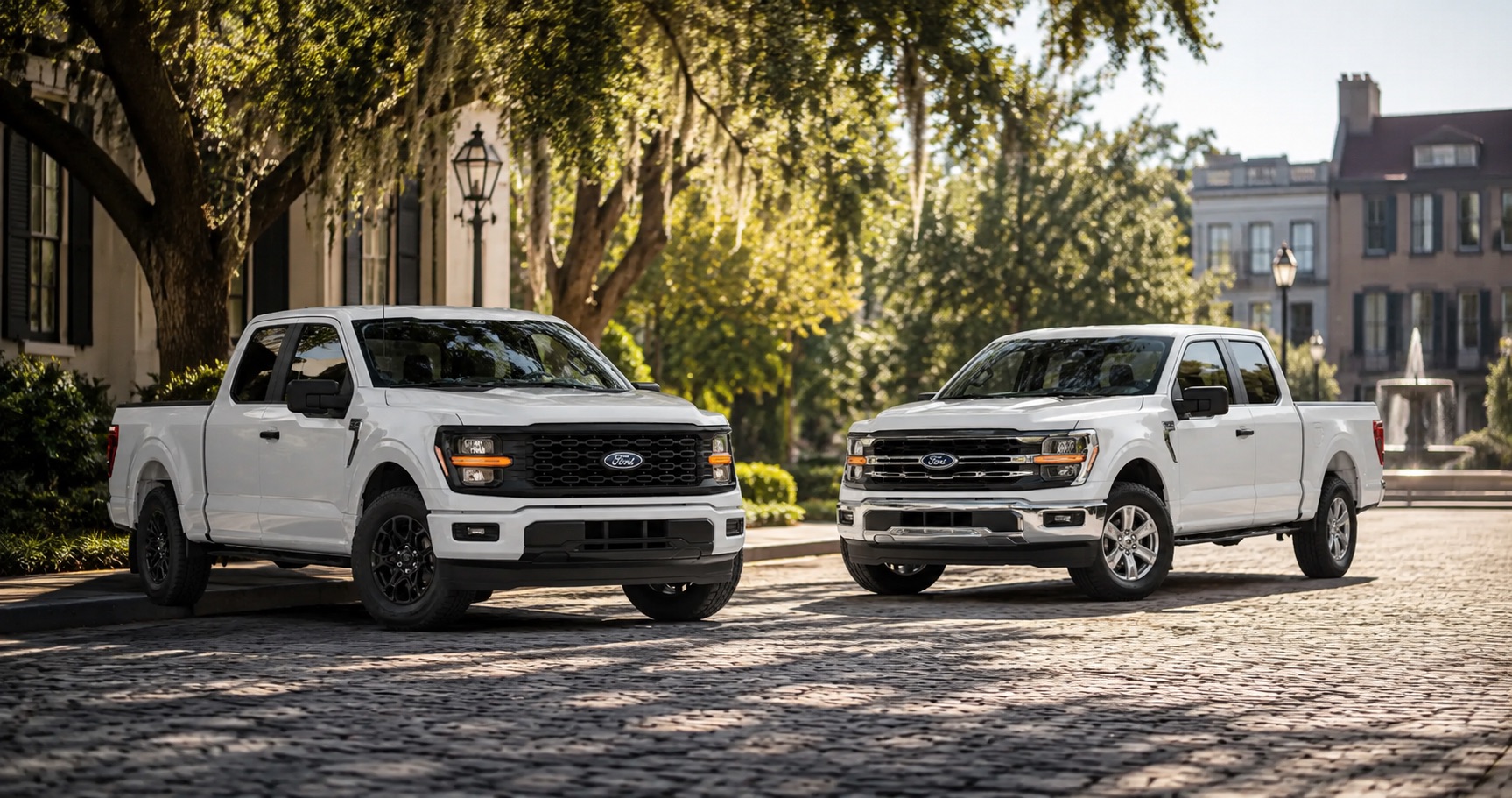
A J.C. Lewis Ford F-150 Trim Comparison
2026 Ford F-150 STX vs XLT
Value, Features & Capability: Keep the STX's lower entry price and sport-focused personality,
or move to XLT for broader engine, towing, comfort, and technology choices?
The 2026 Ford F-150 STX and XLT sit next to one another in the same lineup and share much of the truck underneath, so this is less a question of which F-150 is better than where the worthwhile stopping point lands. STX keeps the entry price lower and gives the truck a sport-focused identity, while XLT broadens the number of ways you can configure capability, convenience, technology, and appearance.
Ford currently lists STX from $41,855 and XLT from $44,695. That $2,840 step is about 6.8% of the STX starting price, which is meaningful without turning the two trims into different classes of truck. The value question is whether the XLT equipment you would actually select changes the way the truck works for you enough to justify the premium.
Around Savannah and the Lowcountry, the answer can change with the job. A daily commuter, boat owner, contractor, or shopper building a street-oriented V8 truck may stop at a different trim than someone who needs the highest towing path or a broader convenience and driver-assistance menu. Compare the exact cab, engine, drivetrain, packages, and window sticker you would buy rather than treating the trim badge alone as the decision.
Buyer-Fit Shortcuts
Which F-150 Role Sounds More Like Your Truck?
Choose the priority that most closely matches how you would configure an F-150. The panel below points to the cleaner starting trim and explains when the other one still deserves a look.
Your Best Fit
Lower Price + Sport Appearance
Start With F-150 STX
Why It Fits
STX preserves the shared 2.7-liter EcoBoost, V8 and hybrid paths while starting $2,840 below XLT and adding its own gloss-black, body-color sport treatment.
Also Compare
Price an XLT if you would otherwise add several STX options and want the 12-inch digital cluster and Zone Lighting standard, or if you want driver-assistance choices that are not offered on STX.
Your Best Fit
V8 Lobo Street-Truck Build
Start With F-150 STX
Why It Fits
The 2026 Lobo Package is an STX-specific branch built around the 5.0-liter V8, a two-inch lowered rear suspension, 22-inch gloss-black wheels, and dedicated street-focused styling.
Also Compare
Choose XLT instead when towing technology, cabin convenience, camera coverage, or driver assistance matters more than the Lobo package's street-truck character.
Your Best Fit
Maximum Towing Ceiling
Start With F-150 XLT
Why It Fits
XLT adds the available 3.5-liter EcoBoost V6 and is the trim Ford specifies for the F-150's 13,500-pound maximum-towing configuration when properly equipped.
Also Compare
STX still deserves a price check when your loaded trailer stays comfortably within the capability of its 2.7-liter, 5.0-liter, or PowerBoost configurations.
Your Best Fit
More Comfort + Driver Tech
Start With F-150 XLT
Why It Fits
XLT standardizes the 12-inch digital productivity screen and Zone Lighting, then opens options such as heated front seats, wireless charging, a 360-degree camera, trailer-assist systems, and BlueCruise on select configurations.
Also Compare
STX remains the cleaner value if the 12-inch center touchscreen, core Co-Pilot360 features, available 12-inch cluster, and simpler cabin already cover your routine.
Your Best Fit
4x4 Work + Weekend Recreation
Compare STX & XLT
Why Both Work
Both can add four-wheel drive, an electronic-locking rear differential and off-road equipment, so ordinary jobsite, boat-ramp and weekend-trail needs do not automatically require XLT.
What Breaks the Tie
Choose STX when its FX4 path and styling are enough. Choose XLT when you also want its broader towing-tech, bed-utility, comfort, appearance, or driver-assistance package menu.
Your Best Fit
PowerBoost Hybrid + Shared Capability
Compare STX & XLT
Why Both Work
Both STX and XLT offer the 3.5-liter PowerBoost Full Hybrid V6 at 420 horsepower and 570 lb-ft, so choosing hybrid power by itself does not require moving to XLT.
What Breaks the Tie
Choose STX when hybrid power, the shared 12-inch SYNC 4 display and the simpler equipment set already cover the mission. Choose XLT when you also want its standard digital cluster, Zone Lighting, or broader towing, camera, comfort and driver-assistance options.
Quick Answers2026 Ford F-150 STX vs XLT
How much more does the 2026 F-150 XLT start at than the STX?
STX starts at $41,855 and XLT starts at $44,695, a $2,840 difference—about 6.8% of the STX starting price—before destination, options, taxes, dealer charges, or incentives.
Do STX and XLT offer the same cab and bed choices?
Yes. Both offer a SuperCab with a 6.5-foot bed or a SuperCrew with a 5.5- or 6.5-foot bed. Neither trim offers the Regular Cab or 8-foot bed.
What engine does each trim use standard?
Both use the 325-horsepower, 400-lb-ft 2.7-liter EcoBoost V6 as the standard engine. Both can also be configured with the 5.0-liter V8 or 3.5-liter PowerBoost full hybrid V6.
Which trim can reach the F-150's 13,500-pound maximum tow rating?
XLT. Ford identifies an XLT SuperCrew 4x4 with the 6.5-foot box, 3.5-liter EcoBoost V6, Tow/Haul Package, and max-tow axle upgrade as the 13,500-pound maximum-towing configuration. The highest engine-level tow path available to STX is 12,800 pounds with the 5.0-liter V8, so the headline gap is 700 pounds, or about 5.5%; exact truck ratings can be lower.
What does XLT add for everyday technology?
XLT makes the 12-inch digital productivity screen and Zone Lighting standard and opens a broader list of options such as a 360-degree camera, Pro Trailer Hitch Assist, Pro Trailer Backup Assist, Trailer Reverse Guidance, wireless charging, heated front seats, adaptive cruise control, and BlueCruise on select configurations.
Is XLT automatically the better value?
No. STX is the cleaner fit when its engine choices, 12-inch center screen, core driver-assistance features, available FX4 equipment, and sport-focused design already cover the mission. XLT earns the extra money when you will actually use its added engine, towing, visibility, comfort, or driver-assistance choices.
STX vs XLT by Decision Point
Where Does the XLT Step Up — & Where Does STX Already Cover the Job?
Select a topic to compare the two trims. On smaller screens, swipe the topic row and data tables horizontally.
At a Glance
Two Adjacent F-150 Trims With One Clear Step-Up Question
The basic truck formula stays the same; XLT mainly buys a wider configuration and technology menu.
At-a-Glance Takeaway
STX already covers the shared truck fundamentals and keeps a distinct style/performance identity. XLT adds more configuration breadth, but even the headline towing step is 700 pounds—about 5.5% above the 12,800-pound V8 engine maximum available to STX—so the upgrade matters most when your exact build actually uses the added ceiling or equipment.
Price & Value
What Does the Extra $2,840 Actually Buy?
The factory warranty and core multimedia foundation are shared; value turns on equipment and configuration flexibility.
Value Takeaway
Because warranty coverage and the main 12-inch SYNC 4 display are shared, XLT's value case should be judged against the specific upgrades you would select—not against the assumption that a higher trim is automatically the smarter purchase.
Engines & Capability
Most Powertrain Choices Overlap — One XLT Engine Changes the Ceiling
Both trims cover the most common EcoBoost, V8 and hybrid paths; XLT alone adds the 3.5-liter EcoBoost V6.
Powertrain Takeaway
Do not buy XLT merely to get a V8 or PowerBoost hybrid; STX offers both. The powertrain reason to step up is the 3.5-liter EcoBoost and the 13,500-pound maximum-towing path it unlocks, a 700-pound increase over the 5.0-liter V8 engine maximum available to STX.
Cabin & Everyday Tech
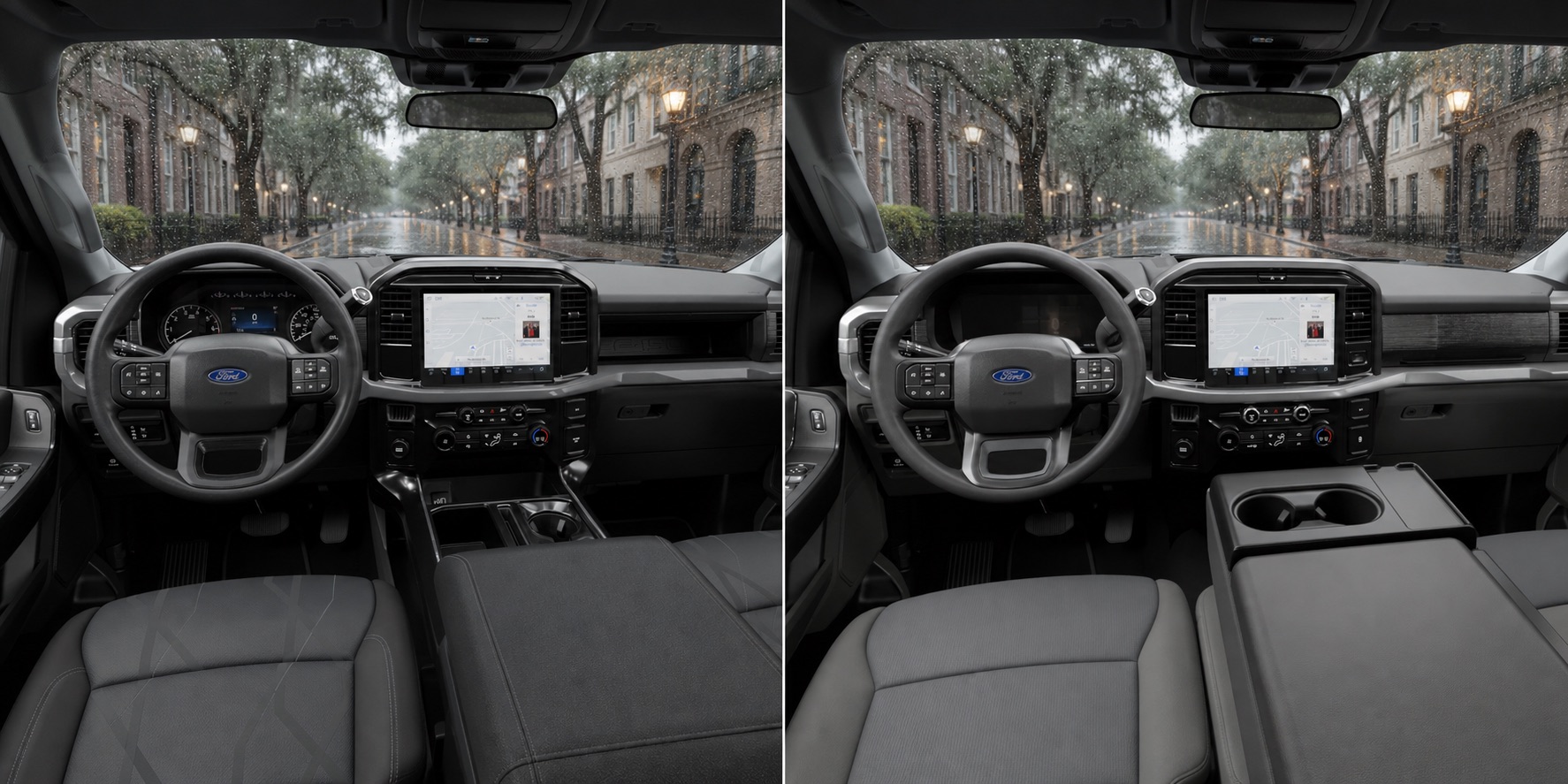
The Center Screen Is Shared; the Driver-Facing Convenience Layer Is Not
STX is not a screen-deprived truck, but XLT standardizes and unlocks more of the features people notice every day.
Cabin Takeaway
XLT's cabin advantage is mostly about what it standardizes or makes available around the shared 12-inch center screen. If you do not care about those driver-facing conveniences, STX avoids paying for an upgrade you may barely notice.
Towing Tech & Driver Assistance
The Hitch Is Shared; XLT Adds More Help Around the Maneuver
For frequent towing or dense daily driving, visibility and assistance options may justify XLT before raw capacity does.
Towing-Tech Takeaway
A shopper towing only occasionally may not need XLT's added assistance systems. For regular boat ramps, trailers, tight parking areas or long I-95 trips, XLT can justify its price through easier setup and visibility even when both trims have enough capacity.
Packages & Appearance
STX Has the More Specific Personality; XLT Has the Broader Menu
The package decision may be more important than the trim name for shoppers building around a particular look or use case.
Package Takeaway
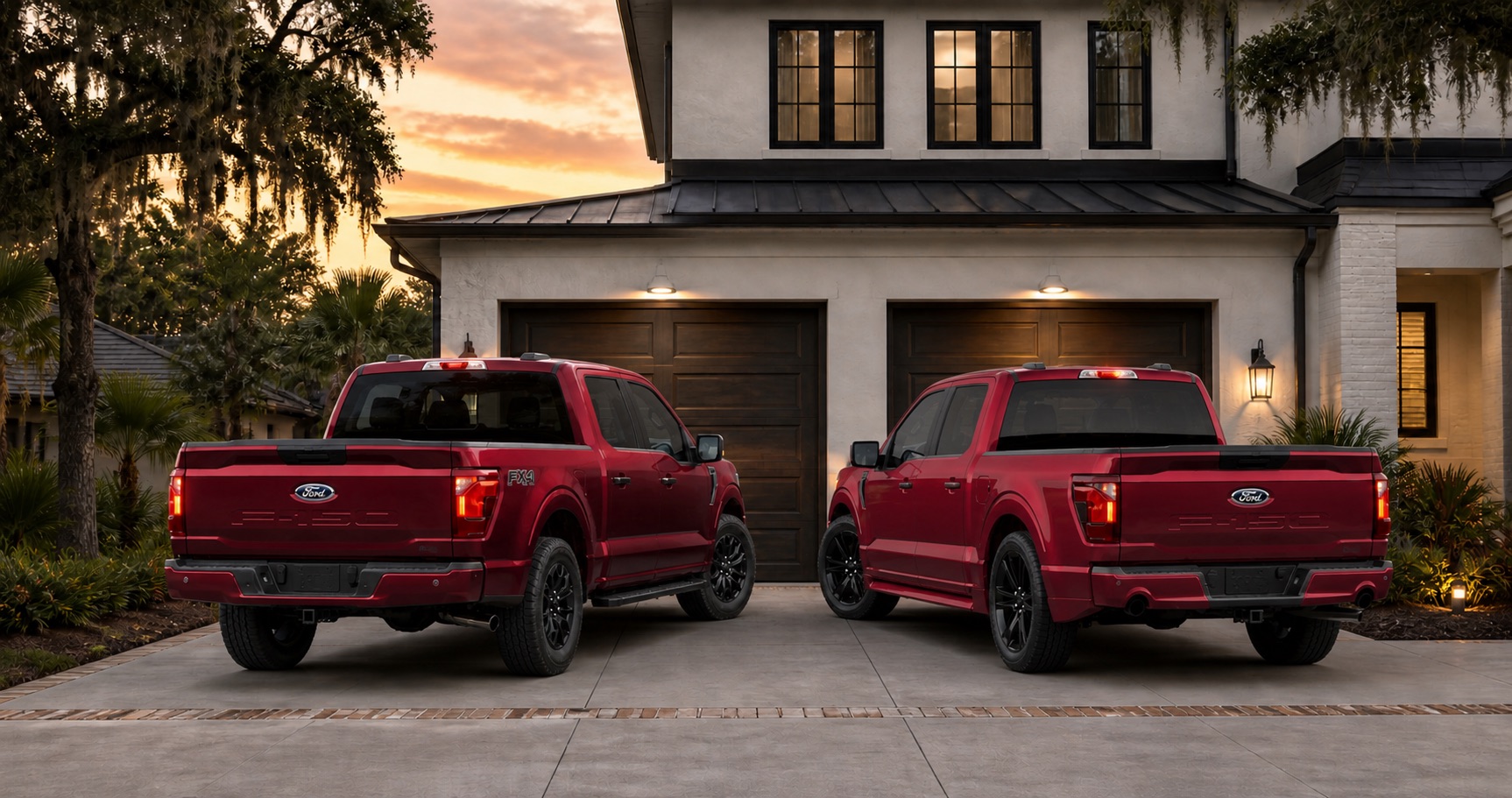
STX is not merely the cheaper XLT; Lobo gives it a 2026 role the XLT cannot duplicate. XLT is the better canvas when the buyer wants to mix towing, bed utility, comfort, assistance and appearance upgrades rather than pursue one specific sport-truck identity.
XLT is the Broad-Option Sweet Spot; STX Keeps a Distinct Role
Car and Driver rates the 2026 F-150 9/10, gives it an Editors' Choice award, and ranks it third among full-size pickups while praising the lineup's engine variety, competitive towing and payload capability, and unusually broad combination of cabs, beds and trims.
Its July 2026 trim-buying guide recommends XLT because it unlocks desirable options while remaining relatively affordable. That aligns with XLT's role here, but the same guide also calls out the new Lobo Package as an affordable V8 street-performance route—supporting the idea that STX is not simply an XLT minus equipment.
Put the Price Step in Context
Compare STX & XLT as Actual Builds, Not Just Starting Prices
An STX with a V8, FX4 equipment, Lobo Package, or added technology can move far from its base price, while an XLT configured around maximum towing, cameras, comfort, or BlueCruise can move farther still. Current inventory and window stickers show what the price difference really buys.
Where the Decision Actually Lands
When Does the XLT Earn Its Extra Base Cost?
STX is the cleaner fit when its shared F-150 fundamentals already cover the workload and the lower entry price, sport-focused appearance, STX FX4 route, or Lobo Package is part of the reason you want the truck. Moving up is not required simply to get a V8, PowerBoost hybrid, 12-inch center display, or useful towing hardware.
XLT earns its extra cost when you will use what the trim uniquely standardizes or unlocks: most notably the 3.5-liter EcoBoost and 13,500-pound maximum-towing path, plus a broader menu of towing assistance, camera coverage, comfort, driver-assistance, bed-utility, and appearance options. The top towing difference is 700 pounds rather than a different capability class, so those equipment choices may matter more than the number itself.
If neither description settles it, compare the exact STX and XLT builds you would buy. The better value is the truck whose finished configuration solves your repeated jobs without paying for capability or convenience you will rarely use.
Use the fit check below to see which side of that boundary your priorities land on.
Fit Check results are general shopping guidance, not a substitute for reviewing current pricing, installed equipment, towing and payload labels, package restrictions, or the individual window sticker.
Common STX vs XLT Questions
2026 Ford F-150 STX vs XLT FAQ
Shopping & Ownership Support
Why J.C. Lewis Ford Makes the STX-vs-XLT Step Easier to Verify
J.C. Lewis Ford has served Savannah since 1912 and remains a family-held Ford operation. For an STX-versus-XLT shopper, that history matters most when it translates into a clearer configuration decision: the dealership emphasizes transparent transactions and F-150 guidance that can keep engine, cab, bed, drivetrain, axle, package, payload, and towing details tied to the actual truck rather than to a brochure maximum or trim badge.
Current F-150 inventory, custom-order support, financing, trade assistance, specialty and commercial truck resources, and remote transaction or home-delivery options can also widen the search beyond the nearest stock unit. That is especially useful when the reason for choosing STX is a specific Lobo or FX4 build, or when the reason for choosing XLT is a 3.5-liter EcoBoost, Tow/Haul, camera, or driver-assistance configuration that may require a more deliberate equipment match.
The ownership side continues through factory-trained Ford service, genuine Ford parts, Mobile Service, and Pickup & Delivery for eligible needs. Those options can reduce the time cost of routine maintenance and selected repairs for Coastal Georgia and Lowcountry drivers whose F-150 has to stay available for commuting, work, towing, family travel, or weekends on the water.
Where to Go Next
Start Shopping or Keep Researching
Use current inventory and purchase tools when you are ready to compare actual STX and XLT builds, or keep researching the F-150 lineup before choosing a configuration.
Start Shopping
Compare Real F-150 Configurations
See current F-150 inventory, price the equipment you want, and move toward financing, trade-in, or a custom order.
Keep Researching
Go Deeper Into the F-150 Lineup
Compare trims, towing, dimensions, and powertrain details before deciding which STX or XLT configuration fits best.
Disclaimers:
*Starting MSRP was checked against Ford Build & Price on September 1, 2026. MSRP excludes destination and delivery, taxes, title, license, options, accessories, dealer-installed equipment, and dealer charges. Pricing, incentives, inventory, and availability can change.
*Horsepower and torque figures are manufacturer ratings and can depend on fuel and configuration. The current 2026 Ford towing data used here lists 325 hp / 400 lb-ft for the 2.7L EcoBoost, 400 hp / 410 lb-ft for the 5.0L V8, 382 hp / 500 lb-ft for the 3.5L EcoBoost, and 420 hp / 570 lb-ft for the 3.5L PowerBoost Full Hybrid V6. Confirm the exact engine and window sticker before purchase.
*Maximum towing requires specific engine, cab, bed, drivetrain, axle, package, tire, and equipment combinations. Passenger, cargo, hitch, accessory, and option weight can reduce available payload and trailer capacity. Never exceed any vehicle rating; review the exact truck's certification labels, payload label, towing guide, and owner's manual.
*Cab, bed, drivetrain, seating, package, lighting, camera, towing-assistance, BlueCruise, comfort, audio, connected-service, Pro Power Onboard, Lobo, FX4, appearance, and utility features vary by configuration and may require additional equipment or subscriptions. Package content and availability can change.
*Ford's New Vehicle Limited Warranty terms apply to both trims. Current Ford owner information lists 3 years/36,000 miles of bumper-to-bumper coverage and 5 years/60,000 miles of powertrain coverage, subject to warranty terms, exclusions, and eligibility.
*Driver-assistance systems are supplemental and do not replace attentive driving, judgment, or the driver's responsibility to control the vehicle. BlueCruise is available only on eligible roads, vehicles, equipment, and service plans and requires driver attention to the road.
*Car and Driver ratings, rankings, awards, and editorial recommendations belong to Car and Driver and can change. Its F-150 rating applies to the model line, not as separate STX and XLT scores.
*The 3-question Fit Check is general shopping guidance. It does not calculate a statistically validated recommendation and is not a substitute for comparing actual vehicle equipment, pricing, towing and payload labels, package restrictions, or a test drive.