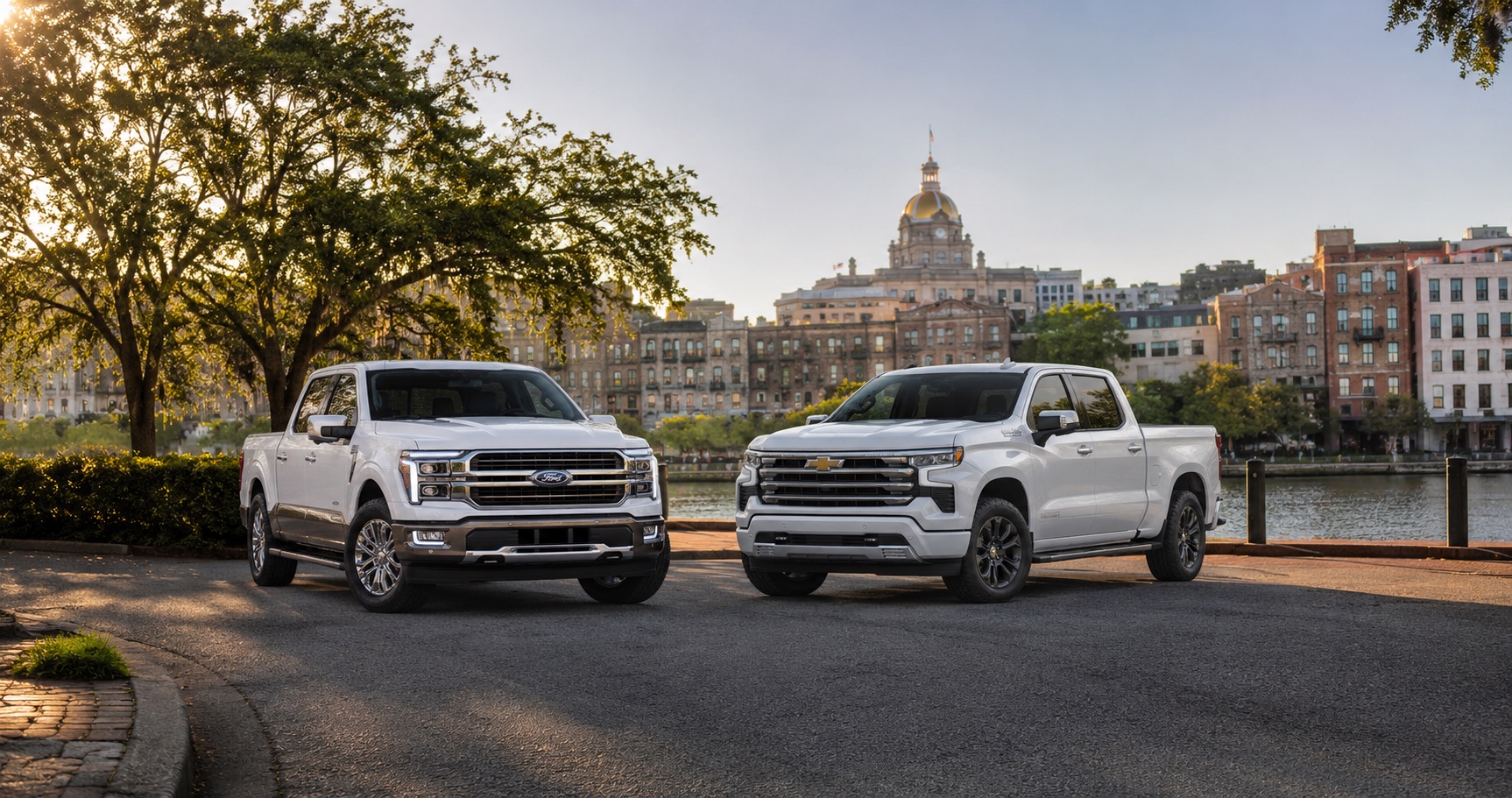
A Full-Size Truck Comparison for Coastal Georgia
2026 Ford F-150 vs Chevrolet Silverado 1500
Higher Peak Tow/Payload Ceilings & Hybrid Utility or Diesel Efficiency, More Bed Volume & Hands-Free Trailering?
The Better Truck Depends on Which Differences Reach Your Routine.
The 2026 Ford F-150 and Chevrolet Silverado 1500 are two highly configurable full-size pickups that can cover commuting, jobsite use, family travel, boat towing, and weekend recreation without forcing every buyer into the same formula. The useful question is not which badge wins the category; it is which truck gives your combination of powertrain, bed, towing, technology, and budget the cleaner path.
On raw capability, the F-150 leads—but the size of each gap matters. Its 13,500-pound maximum tow rating is only 200 pounds, or about 1.5%, above Silverado's 13,300-pound maximum. The 2,440-pound versus 2,260-pound payload difference is more noticeable at about 8.0%. Both are ceiling figures for specific configurations, so an individual truck's cab, bed, engine, drivetrain, axle, options, passengers, cargo, and hitch setup matter more than the badge alone.
Chevrolet creates the larger measurable advantage in the bed: published cargo volume is about 15% higher in comparable long- and regular-bed configurations and about 19% higher with the short bed. Silverado also offers the Duramax diesel and hands-free driver assistance that can remain active while trailering, while F-150 answers with PowerBoost hybrid utility, available high-output onboard electricity, and a wider high-performance off-road ceiling. For Savannah–Lowcountry use, those differences are more likely to shape the decision than the 200-pound towing spread.
Buyer-Fit Shortcuts
Which Full-Size Truck Priority Sounds Most Like Yours?
Choose the priority that matters most. The result gives you a starting point—not a universal winner—and shows why the other truck may still deserve a look.
Your Best Starting Point
Hybrid Power + Onboard Electricity
Start With the Ford F-150
Why It Fits
The 3.5-liter PowerBoost full-hybrid V6 combines 430 horsepower and 578 lb-ft with standard Pro Power Onboard on the hybrid, plus available 7.2-kW output for tools, devices, or campsite use.
Also Compare
Silverado deserves a look if diesel highway efficiency or its larger bed-volume and Multi-Flex Tailgate advantages matter more than hybrid operation and high-output onboard power.
Your Best Starting Point
Diesel Torque + Highway Efficiency
Start With the Chevrolet Silverado 1500
Why It Fits
Silverado offers a 3.0-liter Duramax turbo-diesel with 305 horsepower, 495 lb-ft, strong highway fuel economy, and up to 13,300 pounds of towing. The F-150 does not offer a diesel.
Also Compare
F-150 is the more distinctive alternative if you want hybrid power instead, particularly when onboard electricity, stronger peak payload, or the 13,500-pound maximum towing path matters.
Your Best Starting Point
Maximum Tow + Payload Ceiling
Start With the Ford F-150
Why It Fits
Ford lists up to 13,500 pounds of towing and 2,440 pounds of payload, versus Silverado at 13,300 and 2,260 pounds. That is a very small 1.5% towing advantage and a more noticeable 8.0% payload advantage.
Also Compare
Silverado stays close enough that its Duramax, bed, trailering-camera, or Super Cruise advantages can matter more if your actual trailer and payload remain comfortably inside its ratings.
Your Best Starting Point
Bed Volume + Tailgate Flexibility
Start With the Chevrolet Silverado 1500
Why It Fits
Silverado lists 12 standard tie-downs and roughly 15% more cargo volume in comparable long- and regular-bed configurations, with the short-bed advantage closer to 19%. The available six-function Multi-Flex Tailgate adds another practical distinction.
Also Compare
F-150 may be the better work-utility fit if available Pro Power Onboard or the Pro Access Tailgate is more valuable to your routine than maximum bed volume.
Your Best Starting Point
Hands-Free Driving While Trailering
Start With the Chevrolet Silverado 1500
Why It Fits
On eligible Silverado configurations, available Super Cruise can provide hands-free driver assistance while trailering. Chevrolet also offers up to eight available cameras with as many as 14 views.
Also Compare
F-150 offers available BlueCruise on eligible trims plus Pro Trailer Hitch Assist and Pro Trailer Backup Assist, but hands-free trailering itself is not part of the F-150 BlueCruise proposition.
Your Best Starting Point
V8 + Off-Road Flexibility
Compare F-150 & Silverado
Why It Fits
Both offer naturally aspirated V8 choices and serious factory off-road routes. Ford spans Tremor, Raptor, and Raptor R; Chevrolet offers Custom Trail Boss, LT Trail Boss, and ZR2, including diesel availability on ZR2.
Also Compare
The tie breaks on how far you want to push the build: F-150 reaches farther into high-performance desert-truck territory, while Silverado can combine diesel torque with its factory off-road lineup.
2026 Ford F-150 vs Chevrolet Silverado 1500 in 60 SecondsSix answers that can clarify the truck decision
Which 2026 truck starts lower?
On the manufacturers' base-MSRP figures before destination, Chevrolet lists Silverado 1500 from $36,900 and Ford lists F-150 XL from $37,290, a $390 difference. Compare like-for-like cab, drivetrain, equipment, destination charges, incentives, and actual transaction prices rather than treating that small base gap as a finished-truck comparison.
Which can tow more?
F-150 has the higher published maximum at 13,500 pounds versus 13,300 pounds for Silverado 1500. The 200-pound difference is about 1.5%, and both ratings require specific configurations.
Which has the higher maximum payload?
Ford lists 2,440 pounds for F-150 and Chevrolet lists 2,260 pounds for Silverado 1500, a 180-pound difference of roughly 8.0%. Individual payload labels can be substantially lower once equipment is added.
What is the biggest powertrain difference?
F-150 offers a 430-horsepower PowerBoost full hybrid with onboard electrical power; Silverado offers a 305-horsepower, 495-lb-ft Duramax turbo-diesel that reaches an EPA-estimated 28 mpg highway in the qualifying 2WD configuration. Neither truck offers the other's defining alternative-powertrain route.
Which has the stronger bed-utility advantage?
Silverado has the clearer space advantage: about 15% more published cargo volume in comparable long and regular beds and about 19% more in the short bed. It also has 12 standard tie-downs versus four standard cargo-box tie-down hooks on F-150.
How do warranty and reliability compare?
The basic coverage is essentially tied at 3 years/36,000 miles bumper-to-bumper and 5 years/60,000 miles for the standard gas-powertrain warranty. J.D. Power currently gives the F-150 an 86/100 and the Silverado 1500 an 86/100 Quality & Reliability score. F-150 ranks first and Silverado second in the 2026 Initial Quality Study, while the 2026 Vehicle Dependability Study—based on 2023-model trucks after three years—places Silverado second and F-150 tied for third. That mix does not support a clear long-term reliability winner for the 2026 trucks.
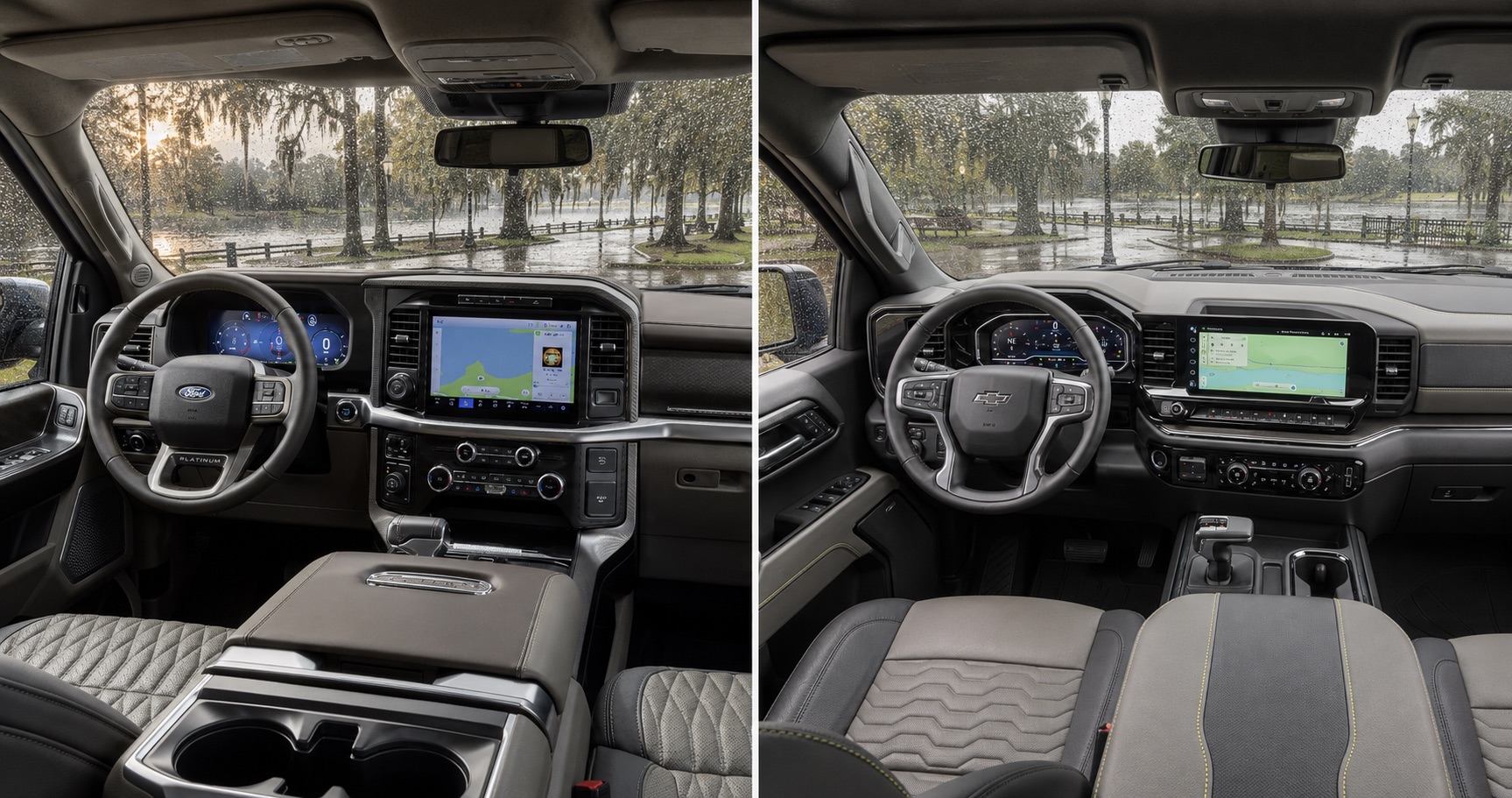
F-150 vs Silverado by Decision Point
Where Does Each Full-Size Pickup Create a Meaningful Advantage?
Select a topic to compare the two trucks. On smaller screens, swipe the topic row and data tables horizontally.
At a Glance
Two Closely Matched Capability Ceilings, Two Different Ways to Use Them
Ford holds the higher maximum towing and payload figures; Chevrolet answers with diesel, bed-volume, and trailering-technology advantages.
At-a-Glance Takeaway
The 1.5% towing gap is too small to define the matchup by itself, while Ford's 8% payload advantage is more meaningful for buyers who can actually use it. Chevrolet answers with roughly 15–19% more published bed volume, plus the Duramax diesel and available hands-free trailering. The stronger truck depends on which of those differences reaches the real workload.
Engines & Energy Paths
Hybrid Utility on One Side; Diesel Efficiency on the Other
Both cover turbocharged entry power and naturally aspirated V8 choices, but their most distinctive alternatives point in different directions.
Powertrain Takeaway
F-150 is the more distinctive choice if hybrid power, strong low-end hybrid torque, exportable electricity, or extreme Raptor performance is central to the purchase. Silverado is the cleaner fit when a half-ton diesel is the priority, and it still gives V8 shoppers two displacement choices.
Towing & Payload
Ford Leads Both Ceilings—About 1.5% in Towing and 8% in Payload
Both trucks reach the 13,000-pound range when properly configured, making exact equipment and real loaded weight more important than the badge.
Capability Takeaway
F-150 owns the higher published maximums, but the towing advantage is only 200 pounds; the 180-pound payload spread is the more meaningful percentage difference. For a boat, camper, equipment trailer, or payload-heavy work setup, the exact truck still matters more than the headline: check its door-jamb payload label, towing guide, hitch limits, axle, tires, passengers, cargo, and installed equipment.
Bed & Work Utility
Silverado Prioritizes Bed Volume; F-150 Prioritizes Power and Access
Chevrolet has the larger measurable bed advantage—roughly 15–19% more published cargo volume—while Ford counters with higher-output bed power and a different tailgate-access solution.
Bed-Utility Takeaway
Silverado has the stronger conventional bed-utility case: about 15% more volume in the long and regular beds, about 19% more in the short bed, and three times as many standard tie-down points. F-150 creates a different kind of utility advantage when high-output Pro Power Onboard or the Pro Access Tailgate is more valuable than extra space and anchor points.
Cabin, Screens & Driver Tech
Ford Standardizes a Large Center Screen; Chevrolet Offers a Larger Upgrade and Trailering-Aware Hands-Free Tech
Both support modern connected-truck use, but the most important differences depend on trim and whether hands-free trailering matters.
Technology Takeaway
F-150 gives every trim a 12-inch center screen and develops its towing-tech advantage around hitching and backing assistance. Silverado’s strongest differentiator is available Super Cruise with trailering, backed by extensive camera coverage. Neither advantage is universal across every trim, so compare the exact equipment group.
Trims, Warranty & Value
The Lineups Are Broad; Ownership Evidence Does Not Create a Clear Reliability Winner
Base warranties are essentially matched, current J.D. Power Quality & Reliability scores are tied, and the more useful ownership differences come from powertrain-specific coverage and included benefits.
Warranty-and-Value Takeaway
The $390 base-MSRP gap is too small to settle a real purchase, and the reliability evidence is essentially a draw rather than a reason to force a winner. Basic warranty coverage matches; Ford adds longer hybrid-component coverage, while Chevrolet gives the Duramax a 100,000-mile powertrain warranty. The better value is still the finished configuration whose powertrain, equipment, price, and ownership support fit the way you will use it.
Independent Review Context
Car and Driver Gives the F-150 the Overall Edge
Car and Driver rates the 2026 F-150 9/10, names it an Editors' Choice, and places it #3 in its current Best Full-Size Pickup Trucks ranking; the 2026 Silverado 1500 earns 8.5/10 and ranks #6. That half-point gap supports the F-150 as the publication's stronger overall pick, but its reviews also reinforce why this remains a legitimate two-sided decision: Ford stands out for configuration breadth and towing and hauling capability, while Chevrolet delivers a wide powertrain range, tidy handling, and useful technology of its own.
Car and Driver
2026 Ford F-150
Rating
9 / 10
Recognition
Editors' Choice
Exceptional configuration breadth and competitive towing and payload capability across a remarkably flexible lineup.
Car and Driver treats the F-150's variety as one of its defining strengths, highlighting its range of engines along with the number of available cab, bed, and trim combinations. The publication also credits the Ford with strong daily usability and competitive towing and hauling capability. For this comparison, that reinforces the F-150's advantage when the buyer wants more ways to configure one truck around work, towing, hybrid utility, comfort, or specialized use.
Car and Driver
2026 Chevrolet Silverado 1500
Rating
8.5 / 10
Broadly capable, tidy to drive, and backed by a powertrain lineup that gives truck buyers several distinct ways to get the job done.
Car and Driver describes the Silverado 1500 as capable across a wide range of configurations and specifically praises its tidy handling and engine variety. That keeps Chevrolet highly relevant despite the lower overall rating: its available diesel, V8 choices, towing capability, and distinct technology options give shoppers meaningful alternatives to Ford's broader configuration and hybrid strategy rather than simply making Silverado the runner-up on every decision point.
Put the F-150 Side in Real-World Context
Compare the F-150 as an Actual Build, Not a Base Price
Cab, bed, engine, 4x4, towing, hybrid, off-road, and technology choices can move the finished truck far from its starting price. Current F-150 inventory lets you compare real equipment and payload labels, while trade value puts that configuration into a more realistic budget.
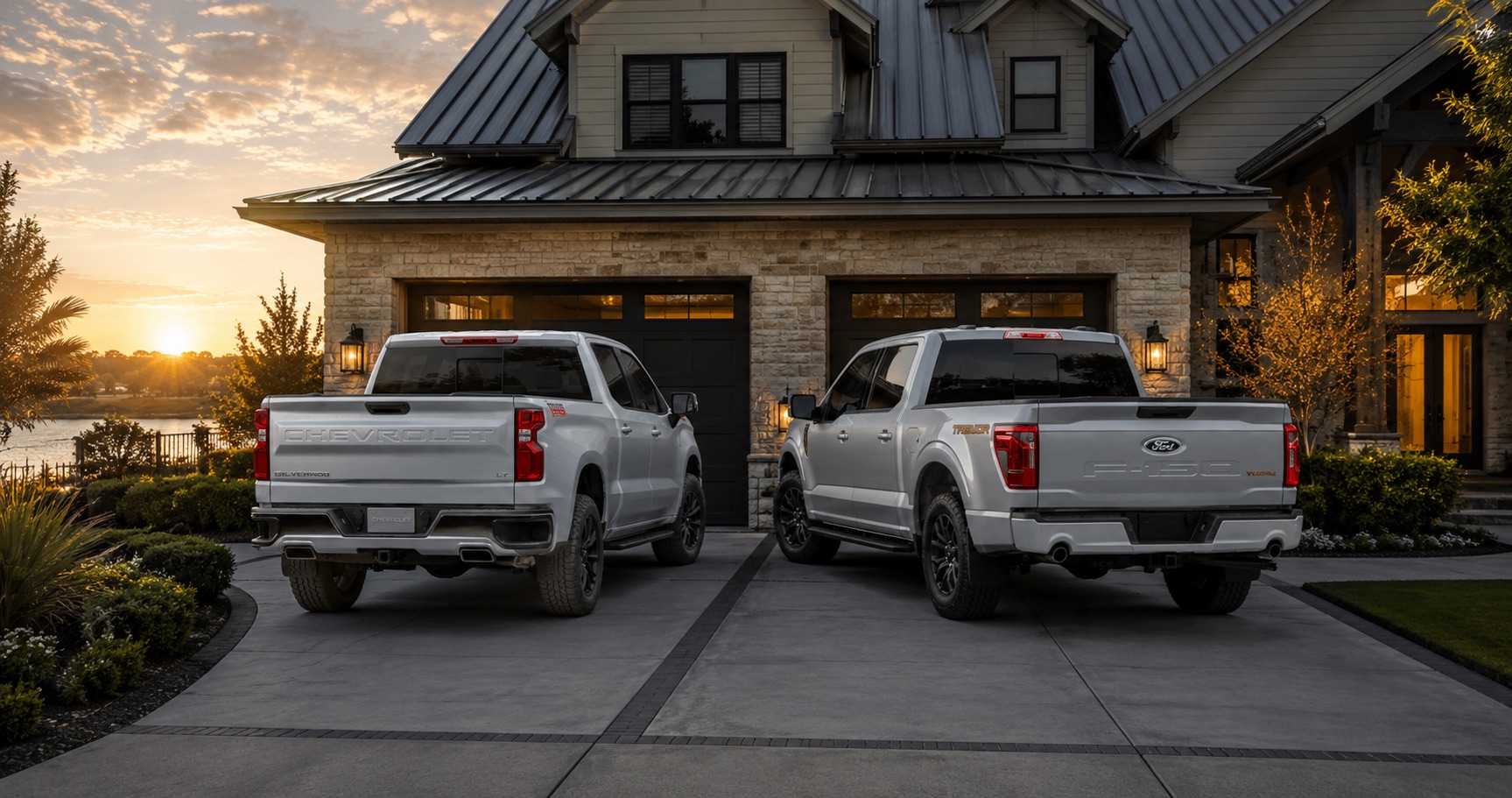
Where the Decision Actually Lands
Which Advantage Is Large Enough
to Change the Truck You Would Actually Buy?
Choose the F-150 for capability only when you can use the margin: its maximum tow rating is about 1.5% higher, while its maximum payload is about 8% higher. Ford's stronger case becomes more distinctive when those numbers pair with PowerBoost hybrid power, high-output Pro Power Onboard, or the Tremor/Raptor end of the lineup.
Silverado's measurable bed advantage is larger—roughly 15–19% more published cargo volume depending on bed length, plus 12 standard tie-downs versus four on F-150. Add the Duramax diesel or Super Cruise with trailering, and Chevrolet can be the more attractive truck even though its maximum towing and payload figures are lower.
Ownership evidence does not break the tie cleanly. Both trucks carry the same baseline 3-year/36,000-mile bumper-to-bumper and 5-year/60,000-mile gas-powertrain coverage, and the F-150 currently scores 86/100 and the Silverado 1500 scores 86/100 for J.D. Power Quality & Reliability. If neither truck's distinctive powertrain, bed, or technology advantage is essential, compare the exact configuration, finished price, warranty that applies to that powertrain, and the service relationship you want to live with after the purchase.
Use the Best-Fit Quiz below to see which side your priorities favor.
Best-Fit Quiz results are general shopping guidance, not a substitute for reviewing current pricing, installed equipment, towing and payload labels, package restrictions, or a test drive.
2026 Ford F-150 vs Chevrolet Silverado 1500 FAQ
Shopping & Ownership Support
Turn the F-150 Side Into an Actual Build
and Ownership Plan at J.C. Lewis Ford
J.C. Lewis Ford has served Savannah since 1912 as a family-held Ford operation. Today, that history is paired with transparent sales guidance, specialty and commercial truck resources, remote transaction support, and eligible home delivery across the Southeast. In this comparison, the useful role is straightforward: turn the F-150's brochure-level advantages into a specific truck you can inspect, price, and verify.
That means checking the actual engine, cab, bed, drivetrain, towing equipment, payload label, technology, and window sticker before deciding that a published maximum applies to your truck. Current inventory can show what is available now, while custom-order, trade, and financing support can help when the PowerBoost, towing, off-road, or equipment combination you want is too specific to leave to chance.
The ownership side is equally relevant for a truck expected to commute, tow boats, work, or travel the Savannah–Lowcountry region. J.C. Lewis Ford provides factory-trained Ford service, genuine Ford parts, eligible Mobile Service and Pickup & Delivery, plus a current 2026 F-150 maintenance guide that separates normal service from towing, heavy-loading, idling, dusty-road, and off-road conditions. That gives the Ford side of the decision a practical support plan after the purchase—not just a sales argument before it.
Where to Go Next
Start Shopping or Keep Researching
Use current F-150 inventory and purchase tools when you are ready to put the Ford side into a real configuration, or go deeper into F-150 capability before deciding.
Start Shopping
Put an Actual F-150 Configuration in the Comparison
See current F-150 inventory and move toward a trade, financing, custom order, or conversation about the equipment you need.
Keep Researching
Go Deeper Into the F-150 Details That Break the Tie
Use model-specific research for trim structure, towing, dimensions, and the current F-150 lineup before choosing a build.
Disclaimers:
*Manufacturer starting MSRPs, specifications, capability figures, and feature availability were checked September 2, 2026. Ford Build & Price lists the F-150 XL from $37,290 and Chevrolet lists Silverado 1500 from $36,900 before destination and other charges. Pricing, incentives, inventory, and availability can change.
*Maximum towing and payload require specific engine, cab, bed, drivetrain, axle, package, tire, and equipment combinations. Passengers, cargo, hitch weight, accessories, and options reduce usable capacity. Never exceed any vehicle rating; review the exact truck's labels, towing guide, and owner's manual.
*F-150 engine figures used here include 325 hp / 400 lb-ft for the 2.7L EcoBoost, 400 hp / 500 lb-ft for the 3.5L EcoBoost, 400 hp / 410 lb-ft for the 5.0L V8, and 430 hp / 578 lb-ft for the 3.5L PowerBoost full hybrid. Silverado figures include 310 hp / 430 lb-ft for TurboMax, 355 hp / 383 lb-ft for the 5.3L V8, 420 hp / 460 lb-ft for the 6.2L V8, and 305 hp / 495 lb-ft for the 3.0L Duramax. Availability varies by configuration.
*Chevrolet's 28 mpg highway Duramax figure applies to qualifying 2WD configurations. Actual mileage varies with vehicle configuration, driving, conditions, maintenance, and other factors.
*Bed volume, tie-down, tailgate, outlet, camera, towing-assistance, driver-assistance, off-road, connected-service, and convenience features vary by trim and equipment. Comparable cargo-box figures used here correspond to each manufacturer's short, regular/standard, and long bed categories; exact cab/bed availability differs.
*Baseline warranty figures reflect current manufacturer coverage summaries and remain subject to the applicable New Vehicle Limited Warranty, exclusions, eligibility, and whichever time/mileage limit occurs first. Ford lists 8-year/100,000-mile hybrid-component coverage for F-150 and Chevrolet lists 5-year/100,000-mile powertrain coverage for the 3.0L Duramax. Chevrolet included-maintenance benefits have separate timing, dealer, service, and program restrictions and can change.
*J.D. Power Quality & Reliability scores can change as data updates. The 2026 Initial Quality Study measures problems experienced during the first 90 days of ownership. The 2026 Vehicle Dependability Study is based on original owners of 2023-model vehicles after three years and is historical context, not a direct prediction of long-term reliability for a 2026 truck.
*Driver-assistance systems are supplemental and do not replace attentive driving, judgment, or the driver's responsibility to control the vehicle. BlueCruise and Super Cruise availability, road coverage, service plans, equipment, and trailering support vary. Super Cruise with Trailering requires an eligible Silverado configuration.
*Car and Driver ratings, rankings, awards, and editorial findings belong to Car and Driver and can change. Ratings cited apply to the model lines, not every individual trim or configuration.
*The 4-question Best-Fit Quiz is general shopping guidance. It does not calculate a statistically validated recommendation and is not a substitute for comparing actual equipment, pricing, warranty terms, towing and payload labels, package restrictions, or a test drive.